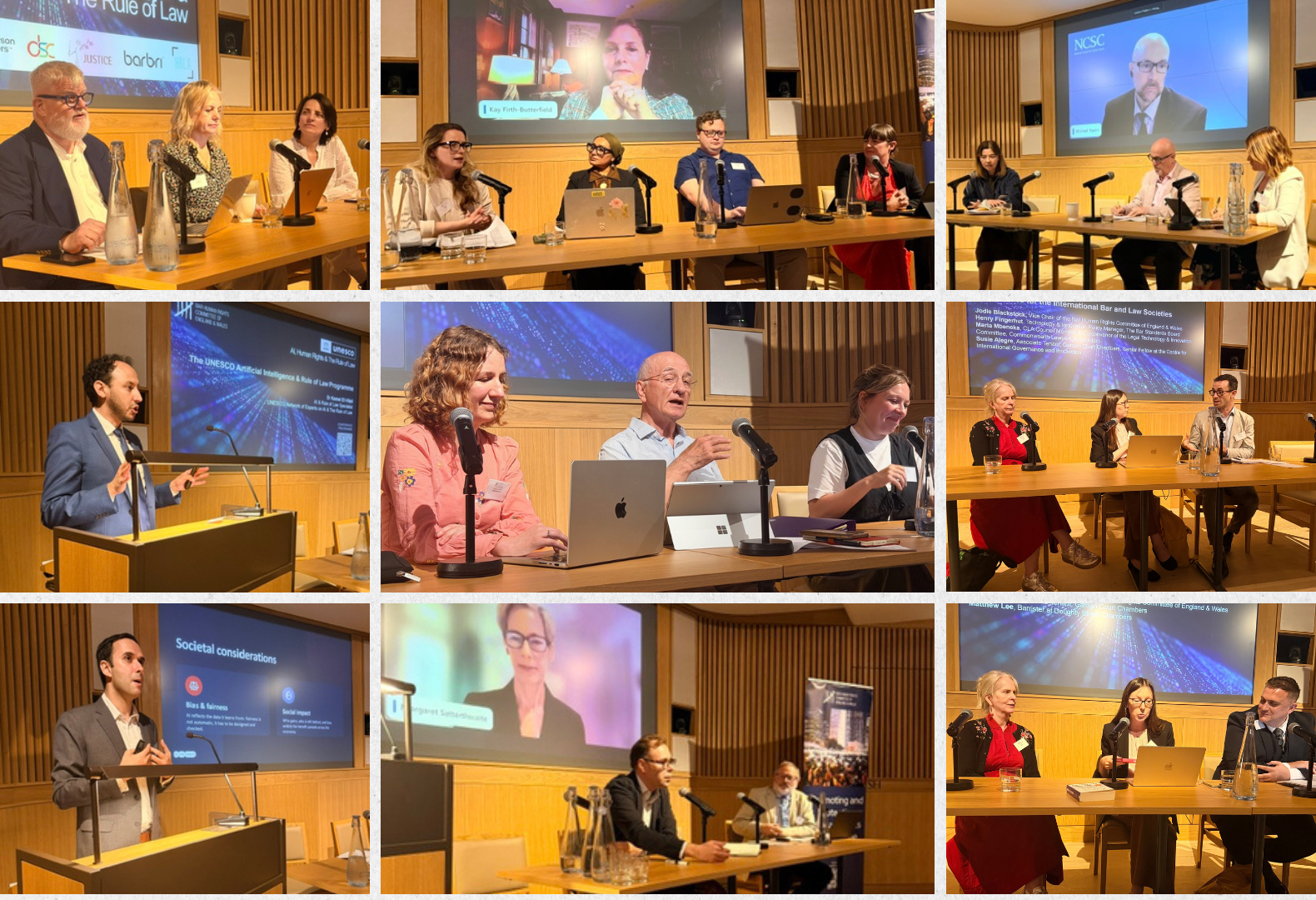
On Saturday 20 June, the Bar Human Rights Committee of England and Wales hosted a full-day seminar, ‘AI, Human Rights & The Rule of Law’, at The Honourable Society of the Inner Temple together with the UNESCO Network of Experts on AI & The Rule of Law, and supported by The Bar Council of England and Wales, Thomson Reuters, BARBRI, Doughty Street Chambers, JUSTICE and the Human Rights Lawyers’ Association.

The seminar opened with welcome remarks and discussion by Michael Ivers KC, Chair of BHRC; Kirsty Brimelow KC, Chair of the Bar Council; and Dana Denis-Smith OBE, Deputy Vice President of the The Law Society. UNESCO’s Dr. Kamel El Hilali presented the UNESCO AI & Rule of Law Programme, before we heard from Cyrus Suntook, Founder of AI for Growth, on how AI is changing the experience of humans at work; and from Katie Fowler, who shared insights on the Thomson Reuters / UNESCO AI Company Data Initiative.
Panels throughout the afternoon examined ‘Civil Society and Policy Responses to AI’ on the growing role of civil society organisations in shaping, scrutinising and responding to the use of AI in justice settings, which was chaired by Katie and welcomed Michael Navin (NSCS), Mary Towers (Law Society) and Professor Andrew Murray (The London School of Economics and Political Science (LSE).
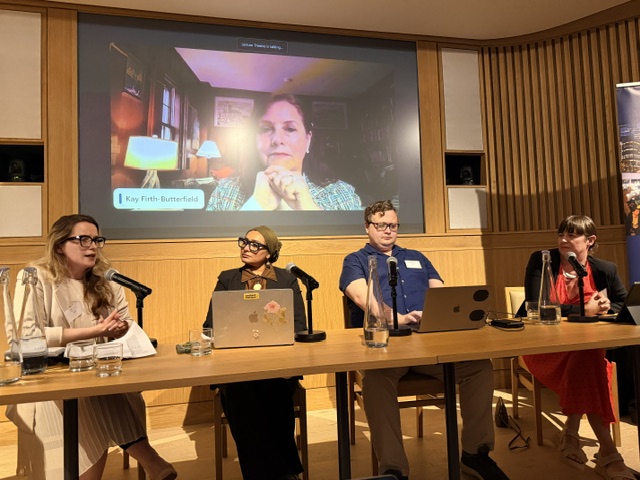
Jodie Blackstock, Vice Chair of BHRC, chaired a panel on the ‘Human Impact of AI in the Justice System’, with Susie Alegre (Garden Court Chambers) and Matthew Lee (Doughty Street Chambers), and a panel on AI guidance produced by the Bar Standards Board, the Commonwealth Lawyers Association and the IBA, welcoming Susie and Henry Fingerhut (BSB). A session on ‘Governing AI in justice: Ethics, risk and accountability in a global context’ was chaired by Louise Hooper (Garden Court Chambers & 100 Brilliant Women in AI Ethics List 2025) and welcomed Nighat Dad (Digital Rights Foundation); Thom Dyke (Deka Chambers); Kay Firth-Butterfield (Good Tech Advisory); and Dr Ewelina Ochab (IBAHRI).
We explored ‘AI, Judicial Independence & Capacity Building’ in a panel chaired by Mark Emerton (HRLA) on addressing deficits in judicial training and the need to safeguard against ‘techno-solutionism’ in the judicial process, with Dr Margaret Satterthwaite, UN Special Rapporteur on the Independence of Judges and Lawyers and Dr John Sorabji (UCL). The final session of the day, on ‘AI, Access to Justice & Human Rights’ was chaired by Ellen Lefley (JUSTICE) with Robin Allen KC (Cloisters Chambers); Professor Yvonne McDermott Rees (Queen’s University Belfast); and Iverna McGowan (OHCHR), and examined the risks and potential uses of AI to bridge gaps in access to justice and to legal information.
BHRC was delighted to welcome practitioners, policymakers, civil society changemakers, students, pupils, trainees and early career lawyers joining us both in person and on Zoom from all over the world, including: Albania, Argentina, Armenia, Australia, Austria, Bangladesh, Belgium, Botswana, Brazil, Brunei Darussalam, Bulgaria, Cambodia, Cameroon, Canada, Colombia, Croatia, Cyprus, Ecuador, Egypt, Finland, France, Georgia, Germany, Ghana, Greece, Hong Kong SAR, India, Indonesia, Ireland, Italy, Japan, Kenya, Kosovo, Latvia, Lithuania, Malaysia, Malta, Mauritius, Morocco, Nepal, Netherlands, Nigeria, North Macedonia, Norway, Oman, Pakistan, Peru, Philippines, Portugal, Romania, Saudi Arabia, Serbia, Singapore, South Africa, Spain, Sri Lanka, Sweden, Thailand, Trinidad and Tobago, Tunisia, Turkey, Turks and Caicos Islands, Uganda, United Arab Emirates, United Kingdom, United States, and Vietnam.
We will be publishing a post-event report with recommendations on the BHRC website in due course. Special thanks to Dr Louise Loder (BHRC / University of Exeter) and Dr Kamel El Hilali (UNESCO / Yale Information Society Project) for co-convening this impactful and timely event.