
The Bar Human Rights Committee of England and Wales (BHRC) and the UNESCO Network of Experts on AI and the Rule of Law are proud to be collaborating on a one-day seminar initiative at Inner Temple, London on Saturday 20 June 2026, examining the transformative potential and risks associated with the use of AI, with particular attention to its impact on human rights, access to justice and the rule of law for justice system stakeholders around the world.
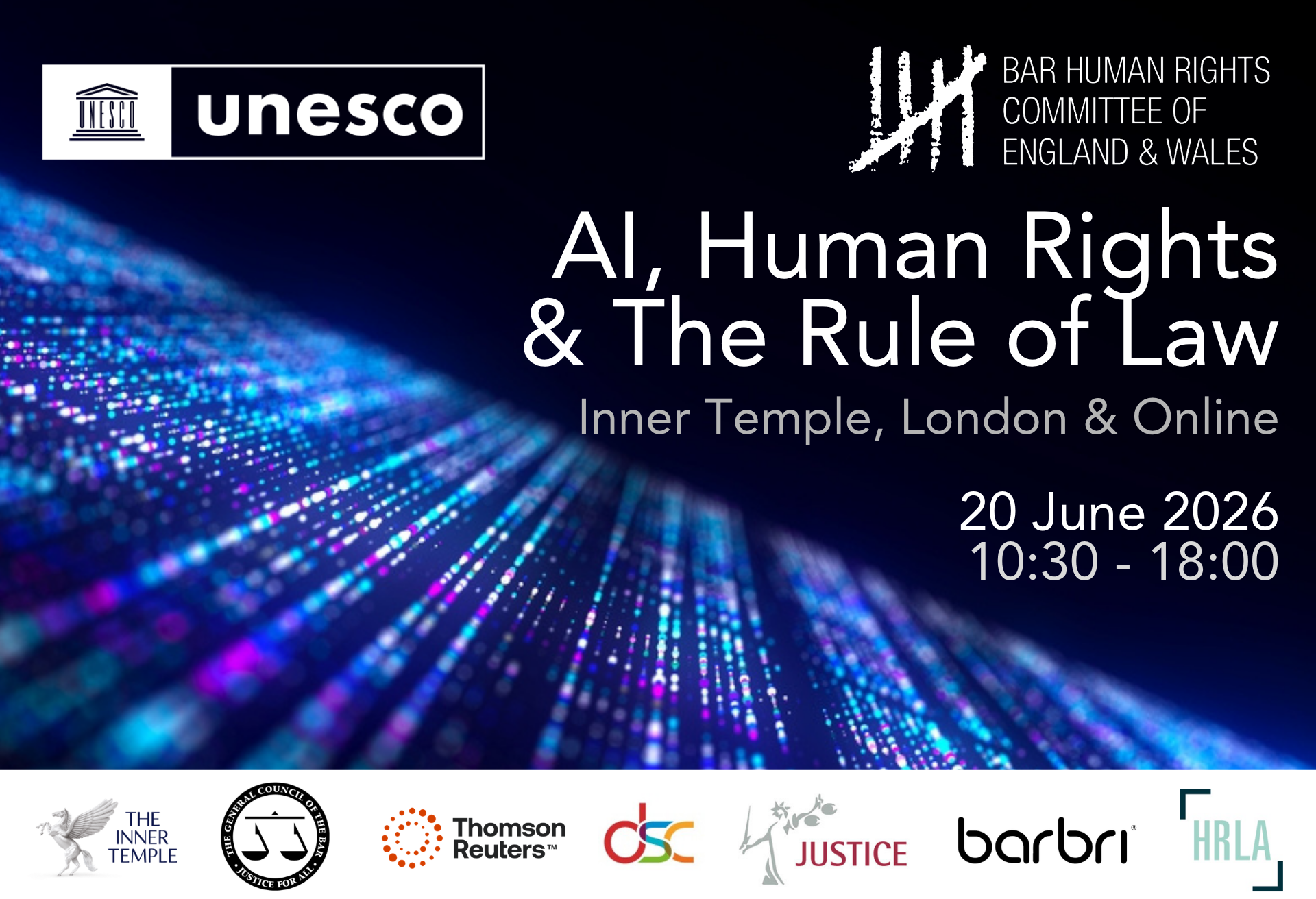
International AI capacity building initiative for Judges, Legal Practitioners, Civil Society and Educators at Inner Temple on 20 June 2026 (10:30-18:00)
BHRC x UNESCO Seminar on AI, Justice & The Rule of Law
Join us at The Honourable Society of the Inner Temple Lecture Theatre on Saturday 20 June 2026 from 10:30 AM (BST) for an engaging and timely training seminar organised by the Bar Human Rights Committee and UNESCO on AI, Human Rights & The Rule of Law. The training, based on the UNESCO Artificial Intelligence and the Rule of Law programme, explores how those working in the justice sector can leverage the potential of AI while ensuring its use remains fair, accountable and rights-respecting. Both in person and online, we look forward to welcoming justice system stakeholders from around the world, including judges, barristers, solicitor advocates, civil society organisations, court administrative officers, pupils / trainees, legal practitioners, legal researchers / academics and students. This event is organised by the Bar Human Rights Committee and UNESCO in partnership with The Bar Council, Thomson Reuters, Doughty Street Chambers, JUSTICE, BARBRI, Inner Temple and the Human Rights Lawyers Association.
DOWNLOAD THE PROGRAMME
Speakers and session chairs include:
Michael Ivers KC, Chair of the Bar Human Rights Committee of England and Wales
Kirsty Brimelow KC, Chair of the Bar Council of England and Wales
Dana Denis-Smith OBE, Deputy Vice President of the Law Society
Margaret Satterthwaite, UN Special Rapporteur on the independence of judges and lawyers
Susie Alegre, Associate Tenant, Garden Court Chambers, Senior Fellow at the Centre for International Governance and Innovation (CIGI), UK
Robin Allen KC, Barrister at Cloisters & Co-founder of the AI Law Consultancy
Kay Firth-Butterfield, Associate Tenant, Doughty Street Chambers & CEO, Good Tech Advisory
Jodie Blackstock, BHRC Vice-Chair & Barrister, Garden Court Chambers
Jo Cecil KC, BHRC Vice-Chair & Barrister, Garden Court Chambers
Nighat Dad, Founder, Digital Rights Foundation, Pakistan
Thom Dyke, Barrister at Deka Chambers & Executive Committee, BHRC
Dr Kamel El Hilali, AI & Rule of Law Specialist, UNESCO
Mark Emerton, Former Board Member of the Judicial College, SSRB Member & Executive Committee, Human Rights Lawyers Association
Henry Fingerhut, Technology & Innovation Policy Manager, The Bar Standards Board, UK
Katie Fowler, Director of Responsible Business, Thomson Reuters Foundation, UK
Louise Hooper, Barrister at Garden Court Chambers, Enforce at the Irish Council for Civil Liberties & 100 Brilliant Women in AI Ethics List 2025
Matthew Lee, Barrister, Doughty Street Chambers
Ellen Lefley, Deputy Legal Director, JUSTICE
Maria Mbeneka, Council Member & Co-Convenor of the Legal Technology & Innovation Committee, Commonwealth Lawyers Association
Professor Yvonne McDermott Rees, Professor in Law at Queen’s University Belfast
Iverna McGowan, Tech & Human Rights Advisor at the UN Office of the High Commissioner for Human Rights, Geneva
Professor Andrew Murray, Dean of the Law School, London School of Economics and Political Science (LSE)
Michael Navin, Principal Court Management Consultant, National Center for State Courts (NCSC), USA
Dr Ewelina Ochab, Senior Programme Lawyer, International Bar Association’s Human Rights Institute
Cyrus Suntook, Co-Founder, AI for Growth and co-author of ‘AI & Sustainability: Leading Responsibly’, Said Business School, University of Oxford
Dr John Sorabji, Associate Professor, Co-Founder & Co-Director of UCL Laws’ Centre for Dispute Resolution, UK
Mary Towers, Technology Law and Responsible Innovation Policy Advisor at The Law Society of England & Wales
For further information, please contact the training convenors Dr Louise Loder (BHRC / University of Exeter) and Dr Kamel El Hilali (UNESCO / Yale Information Society Project).
REGISTER HERE
In person (£28, ticketed) – SOLD OUT
Online (free) – please register here.
PROGRAMME
10:30 AM – 11:00 AM Coffee & Registration (Inner Temple Lecture Theatre)
11:00 AM – 11:30 AM Opening Session | Michael Ivers KC, Chair of the Bar Human Rights Committee of England and Wales; Kirsty Brimelow KC, Chair of the Bar Council; Dana Denis-Smith OBE, Deputy Vice President of the Law Society
11:30 AM – 12:00 PM An overview of the UNESCO AI & Rule of Law Programme
This session, led by Dr Kamel El Hilali (AI & Rule of Law Specialist, UNESCO), will introduce the UNESCO Guidelines for the Use of AI Systems in Courts and Tribunals, which were formally launched at The Athens Roundtable on AI and the Rule of Law in London in December 2025 and set out practical recommendations for judges, court staff, and legal practitioners on the responsible development, procurement, deployment, and use of AI technologies in justice settings. Built around fifteen universal principles, from transparency, accountability, and human oversight to human rights protection and multistakeholder governance, the Guidelines provide practical orientation for judges, court administrators, and policymakers exploring AI adoption. Complemented by a capacity-building toolkit, the Guidelines draw on consultations with experts from over 160 countries, engaging more than 36,000 judicial actors. Dr El Hilali will also discuss the wider UNESCO AI & Rule of Law programme, and opportunities for stakeholders from legal practice, civil society and education to become involved in their implementation.
12:00 PM – 12:30 PM Keynotes | AI, Business & Human Rights
AI, Business and the Human Experience | Cyrus Suntook, Co-Founder, AI for Growth; Co-author, ‘AI & Sustainability: Leading Responsibly’, Saïd Business School, University of Oxford
Responsible AI in practice: Human rights insights from the Thomson Reuters / UNESCO AI Company Data Initiative | Katie Fowler, Director of Responsible Business, Thomson Reuters Foundation
12:30 PM – 01:30 PM Civil Society and Policy Responses to AI in Justice
What are the most critical accountability gaps in how AI is currently being deployed in policy, civil society and in the legal academy, and what should these stakeholders be doing together to close it? This session examines the growing role of civil society organisations in shaping, scrutinising, and responding to the use of AI in justice settings. We’ll understand the practical applications and benefits of use of AI in court systems, and discover innovative tools, resources and programmes developed by judicial institutions and civil society. We will also consider implications for and innovative approaches in legal education, research and professional training, designed to prepare future lawyers with AI literacy and competencies as groundwork for effective and ethical use of AI in future legal / professional practice. With Katie Fowler, Director of Responsible Business, Thomson Reuters Foundation, UK (moderating); Michael Navin, Principal Court Management Consultant, National Center for State Courts (NCSC)*, USA; Mary Towers, Technology Law and Responsible Innovation Policy Advisor at The Law Society of England & Wales; Professor Andrew Murray, Dean of the Law School, London School of Economics and Political Science (LSE), UK
1:30 PM – 2:00 PM Lunch
2:00 PM – 2:30 PM The Human Impact of AI in the Justice System
AI is often presented as a tool for efficiency, productivity and innovation, but the potentially adverse consequences of such use are profoundly human. This session will examine the impact of AI misuse on people who encounter the justice system, particularly those already facing structural disadvantage. The central question that the panel will address is: Can AI be governed in ways that protect the people around the world most affected by its use? With Susie Alegre, Associate Tenant, Garden Court Chambers, and Matthew Lee, Barrister, Doughty Street Chambers, and Jo Cecil KC, BHRC Vice-Chair (moderating).
2:30 PM – 3:15 PM AI Guidance for the international Bar and Law Societies
Professional bodies across jurisdictions are increasingly developing guidance to support the responsible and effective use of AI in legal practice. The session will examine key areas of convergence across emerging governance frameworks, including the need for transparency in the use of AI-assisted outputs, safeguarding confidentiality and legal professional privilege, and ensuring appropriate human oversight and accountability. The session will consider how these principles are being translated into practical guidance for lawyers, identifying commonalities and points of divergence across jurisdictions. With Jodie Blackstock, Vice-Chair BHRC (moderating), and welcoming Henry Fingerhut, Technology & Innovation Policy Manager, The Bar Standards Board; Maria Mbeneka, CLA Council Member & Co-convenor of the Legal Technology & Innovation Committee, Commonwealth Lawyers Association*; Susie Alegre, Associate Tenant, Garden Court Chambers, Senior Fellow at the Centre for International Governance and Innovation.
3:15 PM – 4:15 PM Governing AI in justice: Ethics, risk and accountability in a global context
Following on from the earlier session on AI governance, this session – chaired by Louise Hooper, Barrister at Garden Court Chambers & 100 Brilliant Women in AI Ethics List 2025 – continues the discussion on the ethical implications of the use of artificial intelligence in practitioner and judicial contexts, including algorithmic bias, transparency, inclusion, non-discrimination, fairness in decision-making, privacy, and data security, in the light of growing risks of misuse, systemic discrimination, opaque decision-making, intrusive surveillance of human rights defenders and civil society, and the erosion of fundamental rights and public trust in justice systems. Drawing on frameworks such as the UNESCO 2021 Recommendation on the Ethics of Artificial Intelligence (among others), the session also introduces ethical impact assessment as a practical tool for responsible AI adoption and draws from cross-sector perspectives on AI and sustainability more broadly. With Nighat Dad, Founder, Digital Rights Foundation, Pakistan; Thom Dyke, Barrister, Deka Chambers & Executive Committee, BHRC; Kay Firth-Butterfield, Associate Tenant, Doughty Street Chambers, CEO, Good Tech Advisory*; Dr Ewelina Ochab, Senior Programme Lawyer, IBA’s Human Rights Institute; with Louise Hooper, Barrister at Garden Court Chambers, Enforce at the Irish Council for Civil Liberties & 100 Brilliant Women in AI Ethics List 2025, UK (moderating).
4:15 PM – 5:00 PM AI, Judicial Independence & Capacity Building
As courts and judges around the world increasingly turn to AI, profound questions arise for judicial independence and training. UNESCO’s survey of judicial actors across 96 countries found that 44% are already using AI tools such as ChatGPT in their work, yet only 9% have received any institutional training or guidance, exposing a stark and growing capacity gap. Chaired by Mark Emerton, this session will examine how AI can assist judges without undermining the independent human judgment that judicial decision-making depends on. Drawing on the recent report of the UN Special Rapporteur on the Independence of Judges and Lawyers, which cautions against “techno-solutionism” and insists that human judges must remain in control of decisions about AI in justice systems, and on the Consultative Council of European Judges’ Opinion on assistive technology, the panel will explore the deficits in judicial training and institutional capacity needed to adopt AI responsibly without eroding independence or fairness. With Dr Margaret Satterthwaite, UN Special Rapporteur on Independence of Judges and Lawyers*; and Dr John Sorabji, Associate Professor & Co-Founder & Co-Director of UCL Laws’ Centre for Dispute Resolution, UK.
5:00 PM – 5:45 PM Closing Session | AI, Access to Justice & Human Rights
The session, chaired by Ellen Lefley (Deputy Legal Director, JUSTICE), will explore how AI can be harnessed to widen access to justice, helping people understand their rights, navigate legal processes, and obtain reliable legal information while ensuring that its deployment strengthens, rather than erodes, the institutions on which the rule of law depends. The discussion will consider AI’s potential to improve court administration, support self-represented litigants, and make legal information more accessible and trustworthy, alongside the risks of misinformation, unequal access, and diminished public confidence in justice. Drawing on emerging international standards, including UNESCO’s guidance for courts and tribunals and JUSTICE’s rights-based framework to guide AI use across the UK justice system, the panel will identify the practical safeguards, transparency requirements, and forms of meaningful human oversight needed to ensure that AI helps build fair, accessible, and peaceful rule-of-law-based institutions. With Robin Allen KC, Barrister at Cloisters & Co-founder of the AI Law Consultancy; Professor Yvonne McDermott Rees, Professor in Law at Queen’s University Belfast, UK; Iverna McGowan, Tech & Human Rights Advisor at the UN OHCHR*, and Ellen Lefley, Deputy Legal Director, JUSTICE (moderating).
HOW TO GET THERE

Please view the Inner Temple website for travel guidance.